The GMFCS, MACS and CFCS are all tools used by therapists and researchers to help classify the functional capabilities of individuals with CP. This research article provides evidence of their stability over time.
The GMFCS can be a helpful tool in clinical and research use and has been shown to be stable and accurate over time. It can also help individuals and families better understand cerebral palsy.
Adults with Cerebral Palsy have unique care needs related to physiological changes that occurred with growth and development with Cerebral Palsy, including mental health, yet experience many barriers to proper care.
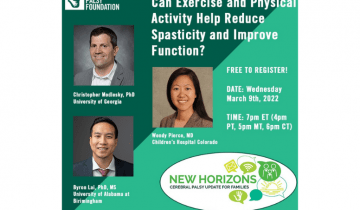
Our educational series continues with this virtual event featuring a multi-disciplinary panel discussion on exercise and physical activity and its impacts on spasticity and function.
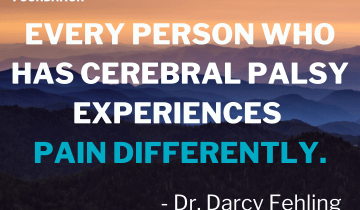
The Cerebral Palsy Foundation has created a factsheet to help guide you in understanding and treating pain with CP. This fact sheet has been created for individuals with cerebral palsy to provide basic guidance surrounding common causes and potential treatment of pain.
The Cerebral Palsy Foundation has created a checklist to help guide you in living the healthiest life possible. This checklist has been created for adults with cerebral palsy to provide basic guidance surrounding routine and additional screenings that should occur as part of your primary and preventive care.
The purpose of this study is to explore the breast cancer screening experiences of women with CP with the aim of identifying factors that could improve screening rates for women with disabilities.
Adults with Cerebral Palsy have unique care needs related to physiological changes that occurred with growth and development with Cerebral Palsy, including mental health, yet experience many barriers to proper care.
Though the initial insult or injury to the brain that causes cerebral palsy is non-progressive, aging with cerebral palsy and lack of physical activity during critical periods of development can impact biologic and metabolic function for adults with cerebral palsy.
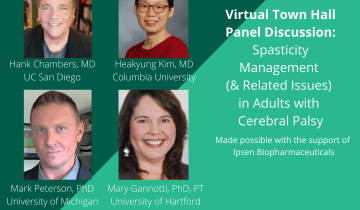
Our educational series continues with this virtual event featuring a multi-disciplinary panel discussion on spasticity management and related issues for adults with Cerebral Palsy!
Cohort-based whole exome and whole genome sequencing and copy number variant (CNV) studies have identified genetic etiologies for a sizable proportion of patients with cerebral palsy (CP). These findings indicate that genetic mutations collectively comprise an important cause of CP.
CPF Executive Director Rachel Byrne talks with Lily Collison and her son Tommy about their journey with Cerebral Palsy, Lily's new book, Tommy's work and much more.
Can there be a genetic cause of Cerebral Palsy in some cases? Let's Talk CP host, Cynthia Frisina talks with Dr. Michael Kruer about this topic and his ground-breaking research in Part 2 of a two-part discussion about the possible genetic causes of CP. When Michael Kruer was in medical school, he knew he wanted to work with children. With advancements in gene therapy opening up incredible opportunities in neuroscience, he realized he could be a part of something much bigger than himself and give children affected by movement disorders like cerebral palsy hope that didn’t seem possible just a few years ago.
Our educational series continued with a panel of experts from Nationwide Children's Hospital on Monday, March 29th, 2021. This virtual event featured a multi-disciplinary panel discussion.
If you're interested in learning more about what is involved with genetic testing and how a visit with a genetic counselor might be helpful, join Cynthia Frisina, the host of Let's Talk CP, as she dives deep with licensed genetic counselor, Danielle Lemke and they talk about what genetic counseling really is, how it can help and what it might be used for as it relates to potential genetic causes of cerebral palsy.
Can there be a genetic cause of Cerebral Palsy in some cases? Let's Talk CP host, Cynthia Frisina talks with Dr. Michael Kruer about this topic and his ground-breaking research in Part 1 of a two-part discussion about the possible genetic causes of CP. When Michael Kruer was in medical school, he knew he wanted to work with children. With advancements in gene therapy opening up incredible opportunities in neuroscience, he realized he could be a part of something much bigger than himself and give children affected by movement disorders like cerebral palsy hope that didn’t seem possible just a few years ago.
An international study recently published in the journal Nature Genetics has provided the first firm evidence that for a substantial number of people, their cerebral palsy (CP) may be caused by a genetic mutation, or mis-spelling in the body’s DNA blueprint.
"In addition to commonly associated environmental factors, genomic factors may cause cerebral palsy. We performed whole-exome sequencing of 250 parent–offspring trios, and observed enrichment of damaging de novo mutations in cerebral palsy cases."
If you’re a history nerd like me, then you probably wondered about the origin of cerebral palsy at least once in your life. As an ever-inquisitive kid, that was certainly at the forefront of my mind, especially when I was old enough to truly comprehend that I had CP.