Search
150 results found
Narrow Results

Contributor

New Horizons Virtual Town Hall 1- Weinberg Family Cerebral Palsy Center at Columbia University
Our educational series kicked off with a panel of experts from the Weinberg Family CP Center at Columbia University Irving Medical Center in New York City on Thursday, November 5th, 2020 at 6:30pm ET. This virtual event featured a multi-disciplinary panel discussion with Weinberg Family CP Center clinicians and researchers.
Blue crown symbol in the upper left corner next to the word Columbia Weinberg Family Cerebral Palsy Center
EazyHold
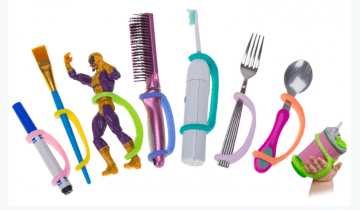
The EazyHold® universal cuff is the answer to gripissues that parents, occupational therapists, schools, hospitals, and care facilities have been seeking. The patented design, available in multiple sizes, gives children and adults the ability to hold onto and use tons of items with ease.
EazyHold
State of the Evidence Traffic Lights 2019
Purpose of review: Cerebral palsy is the most common physical disability of childhood, but the rate is falling, and severity is lessening. We conducted a systematic overview of best available evidence (2012-2019), appraising evidence using GRADE and the Evidence Alert Traffic Light System and then aggregated the new findings with our previous 2013 findings. This article summarizes the best available evidence interventions for preventing and managing cerebral palsy in 2019.
Icon of microscope against documents against gray background
My Journey of Finding Accessible Apartments
As an undergraduate student in a major metropolitan city like NYC, the thought of finding a place to live after graduation was very daunting. I didn’t have many options for accessible dorms on campus, so I could only wonder how much more difficult it’d be to find a “real-life adult” apartment that I could afford as a 20-something-year-old. My apartment search began one year earlier than
Words "My Journey of Finding Accessible Apartments" with a picture of an apartment building with a magnifying glass over it.
30th Anniversary of the Americans with Disabilities Act
The historic Americans with Disabilities Act (ADA) was signed into law on July 26, 1990, by President George H.W. Bush — marking this month its 30th anniversary. The ADA was the country’s first-ever comprehensive civil rights law for people with disabilities, offering protection against discrimination and imposing accessibility requirements in workplaces and the public. The passage of this law was
Text: 30th Anniversary of the Americans with Disabilities Act
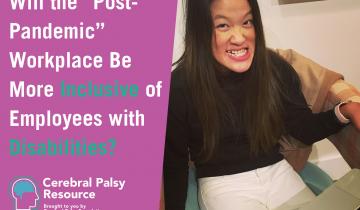
Will the “Post-Pandemic” Workplace Be More Inclusive of Employees with Disabilities?
As cities and states across the countries are lifting the COVID-19 lockdown orders, people are returning to work at their offices. However, since the virus is still very much going around, employers must be vigilant about keeping their workplaces as safe as possible. Although we might be seeing a sense of “normalcy,” there’s still a long way to go before reaching the pre-pandemic normalcy—if we
Sarah Kim sitting at a desk doing work. Text is article title Will the “Post-Pandemic” Workplace Be More Inclusive of Employees with Disabilities?
CP: The Early Years
Around the age of six all children are going off to school. Children move from explorative play, which is fairly informal to a much more formal day. That can be a lengthy day and it's quite structured. There are a lot of challenges faced by children with cerebral palsy throughout the school year.
A screenshot from the YouTube video, "The Early Years"
Mastery Motivation
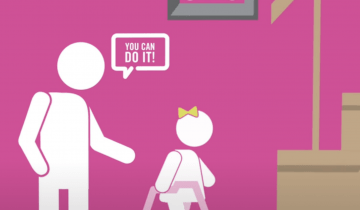
There are a couple of key things to think about in helping children and adolescents make the transition into young adulthood and independence. One of those things is called mastery motivation and we can see mastery motivation early in life. It's the ability to persist in the face of challenge. If you're growing up with a disability, it can be harder to do things. If you are not challenged, if the environment is not set up correctly, or if you don't have the resources, then you start to feel that you can't master certain kinds of tasks.
Representation of a parent cheering on their child with a text bubble above them that reads "You can do it!", while the child who uses a walker prepares to go up the stairs
Finding Your Passion
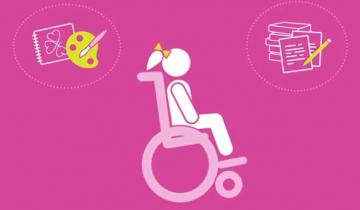
We all have different towns and we all have different things that we do in the course of the day. It may be that the student is a great artist or a great writer. When it comes to assistive technology we have to think about what is going to give that student the ability to do what they love without having to see roadblocks and go, "I can't do that”. There are so many tools out there, whether it's a communication app, a video app, a math tool. With assistive technology you are not making the student into what you want them to be.
A screenshot from the YouTube video, "Finding your Passion"
The Complexity of Acceptance
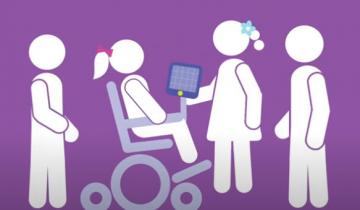
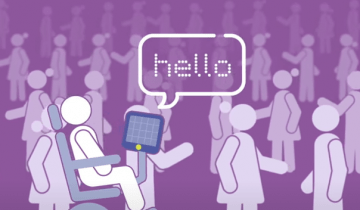
When you use alternate means of communication it can be really frustrating to go out in community. It is hard to know whether people are understanding you and whether they will take the time to listen. A lot of times it's hard for people to admit that they're not always comfortable with a device or a wheelchair or person who does things differently. So the more we can expose and educate people the better off we all will be. When we talk about acceptance, we're not just talking about people in society accepting people with disabilities. We're also talking about people with disabilities who are using alternate means of communication and how difficult it is for them to be out in the community.
Representation of a person in a wheelchair using assistive technology to communicate with a group of people around them.
Accessing the Classroom
In order to get a good education, children need to access the curriculum. That's at the heart of their education. Some of the key challenges of getting students both their education and access to their voice in the class is simply understanding. Preparation for the student with disabilities is key. We have to foster success. We have to build a sense of success in the beginning. That starts with understanding the abilities of that student.
A screenshot from the YouTube video, "Accessing the Classroom"
Accessibility Features
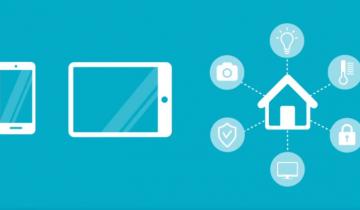
Many of our products today have accessibility supports in them to the extent where we don't have to purchase anything else. It's already in there. Your phone, your tablet, your smart home devices. If you're going to look for these features on your devices, you can start in your settings. There should be something in there that says accessibility. Go in there, see what's available. The manufacturers have done a really nice job of describing these features right within the settings to give you a sense of what they're going to do.
An image of a smart phone and tablet on a blue background
What Companies and Schools Should Learn About Disability Accommodations from the COVID-19 Outbreak
As the COVID-19 outbreak continues to sweep through the country, there are increasing orders from local governments for residents to stay at home, unless they’re essential workers. Both professionals and students are relying on Zoom and other video conferencing software to work or learn from the comforts of their home, although such measures, in most cases, were not permitted before the pandemic.
"Learning from Disability Accommodations for COVID-19" written in text next to an image of writer, Sarah Kim