Search
184 results found
Narrow Results

Contributor

Will the “Post-Pandemic” Workplace Be More Inclusive of Employees with Disabilities?
As cities and states across the countries are lifting the COVID-19 lockdown orders, people are returning to work at their offices. However, since the virus is still very much going around, employers must be vigilant about keeping their workplaces as safe as possible. Although we might be seeing a sense of “normalcy,” there’s still a long way to go before reaching the pre-pandemic normalcy—if we
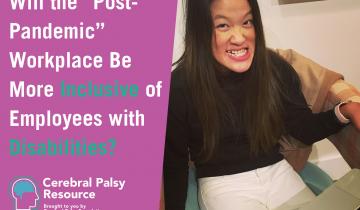
Sarah Kim sitting at a desk doing work. Text is article title Will the “Post-Pandemic” Workplace Be More Inclusive of Employees with Disabilities?
Risky Behavior
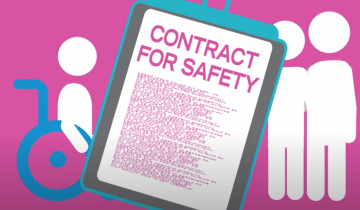
All adolescents and young adults experience some peer pressure to engage in drinking or other risky behaviors. Adolescents with cerebral palsy engage in risky behaviors just like other teenagers. Some families find it helpful to sign what's called, a Contract for Life, or a Contract for Safety, with their child. The parent agrees not to yell in the moment and to have a conversation about it the next day. That's one way that adolescents and parents can create some zone of safety around drinking.
Family holding a contract for safety
People with Disabilities Also Have Diverse Sexualities and Gender Identities
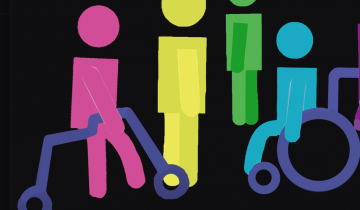
A year ago, I wrote in my Forbes column about the decades-long pattern of Pride Month celebrations excluding people with disabilities. The underlying reason why Pride events were (and still are) mostly inaccessible for people with disabilities, both in terms of physical spaces and social acceptance, is that mainstream media and public don’t see them having identities outside of their disabilities.
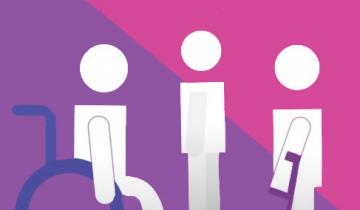
"People with Disabilities Also Have Diverse Sexualities and Gender Identities" is written in text above a representation of different people, some using wheelchairs, some using crutches, some standing without assistance. The representations of people are all in different colors reminiscent of the pride flag
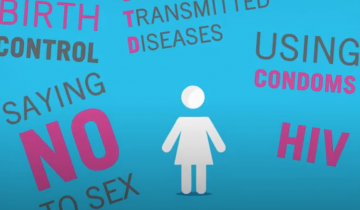
Talking About Sex
Up to 50% of adolescents with cerebral palsy have an intellectual disability, as well as a physical disability. Adolescents with intellectual disabilities still need sexual health education, they just need it in a way that's more individualized so that they can understand it and use it.
Representation of a woman surrounded by sexual education related text
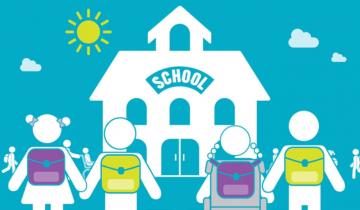
CP: The Early Years
Around the age of six all children are going off to school. Children move from explorative play, which is fairly informal to a much more formal day. That can be a lengthy day and it's quite structured. There are a lot of challenges faced by children with cerebral palsy throughout the school year.
A screenshot from the YouTube video, "The Early Years"
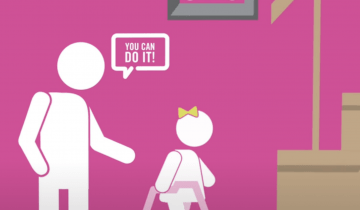
Mastery Motivation
There are a couple of key things to think about in helping children and adolescents make the transition into young adulthood and independence. One of those things is called mastery motivation and we can see mastery motivation early in life. It's the ability to persist in the face of challenge. If you're growing up with a disability, it can be harder to do things. If you are not challenged, if the environment is not set up correctly, or if you don't have the resources, then you start to feel that you can't master certain kinds of tasks.
Representation of a parent cheering on their child with a text bubble above them that reads "You can do it!", while the child who uses a walker prepares to go up the stairs
The Complexity of Acceptance
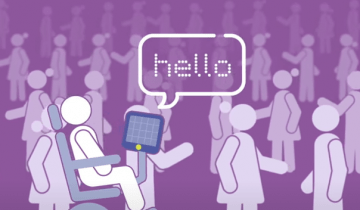
When you use alternate means of communication it can be really frustrating to go out in community. It is hard to know whether people are understanding you and whether they will take the time to listen. A lot of times it's hard for people to admit that they're not always comfortable with a device or a wheelchair or person who does things differently. So the more we can expose and educate people the better off we all will be. When we talk about acceptance, we're not just talking about people in society accepting people with disabilities. We're also talking about people with disabilities who are using alternate means of communication and how difficult it is for them to be out in the community.
Representation of a person in a wheelchair using assistive technology to communicate with a group of people around them.
Accessing the Classroom
In order to get a good education, children need to access the curriculum. That's at the heart of their education. Some of the key challenges of getting students both their education and access to their voice in the class is simply understanding. Preparation for the student with disabilities is key. We have to foster success. We have to build a sense of success in the beginning. That starts with understanding the abilities of that student.
A screenshot from the YouTube video, "Accessing the Classroom"
What Companies and Schools Should Learn About Disability Accommodations from the COVID-19 Outbreak
As the COVID-19 outbreak continues to sweep through the country, there are increasing orders from local governments for residents to stay at home, unless they’re essential workers. Both professionals and students are relying on Zoom and other video conferencing software to work or learn from the comforts of their home, although such measures, in most cases, were not permitted before the pandemic.
"Learning from Disability Accommodations for COVID-19" written in text next to an image of writer, Sarah Kim
How I’ve Learned to Celebrate My Late Birth Mother
Saturdays were special as a kid growing up in Port Washington, New York. Saturdays meant Burger King outings with my grandparents, a great big slice of trade-marked Hershey’s chocolate pie for me and piping hot oatmeal for them. And we can’t forget about the Kids Meal toys. But on this particular Saturday, everything was different - at the tender age of five, I started to notice that certain aspects of my life were just off.
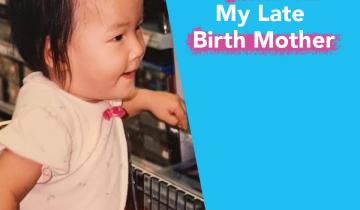
"How I’ve Learned to Celebrate My Late Birth Mother" written in text to the right of an image or writer, Sarah Kim, as a child
Friendships in the Time of COVID-19
I don’t know if this is just me, but my time in quarantine has made me have weird flashbacks to my childhood. As a kid growing up with CP, especially with a speech impediment and mobility limitations, my lifeline to making and keeping friends was through AIM (AOL Instant Messenger, for those of you who are too young to remember) and one of the first video chatting platforms, ooVoo. Fast forward 15 years, many of us are in a similar situation. To slow the spread of COVID-19, most of life has moved online, including friendships.
"Friendships in the Time of COVID-19" written in text below an image of writer Sarah Kim