Making informed decisions about care and treatment for cerebral palsy (CP) can be overwhelming, especially with the vast amount of medical research available. Through this guide, we aim to help you better understand the types of research you may encounter and provides practical tips for evaluating studies relevant to CP.

In Episode 4 of Coffee Talk, Nathalie and Jen discuss research and clinical trials.
Dr. Golda Milo-Manson discusses common sleep issues and solutions in cerebral palsy.
In Episode 2 of Coffee Talk, Nathalie and Jen discuss their experiences with sleep as it has impacted their sons and their lives.
Early diagnosis begins with a medical history and involves using neuroimaging, standardized neurological, and standardized motor assessments that indicate congruent abnormal findings indicative of cerebral palsy. Clinicians should understand the importance of prompt referral to diagnostic-specific early intervention to optimize infant motor and cognitive plasticity, prevent secondary complications, and enhance caregiver well-being.
Our research shows that higher Bone Mineral Density (BMD) was associated with a greater risk of fracture, which is opposite of what we would expect. When we picked apart the BMD ratio we found that bone size had the strongest association with fracture risk, such that smaller bones had a greater risk.
CPF Executive Director Rachel Byrne and Chris Modlesky, PhD discuss exercise, fitness, research, research funding and his current research.
Good nutrition is critical for your child's healthy brain development. It's not uncommon for families to struggle getting enough food to eat. If you feel like you haven't had enough food to feed your whole family in the last month, please talk to someone. This is a common problem.
CPF Executive Director Rachel Byrne and Jocelyn Cohen, Vice President of Communications and Engagement at Cerebral Palsy Alliance Research Foundation discuss collaboration in research.
Oropharyngeal dysphagia, or OPD, is an impairment of the oral or pharyngeal phases of the swallow. This can impair muscle movements and coordination of the mouth, such as the lips, tongue, jaw, cheeks, palate, and also muscles of the pharynx and the entry to the airway.
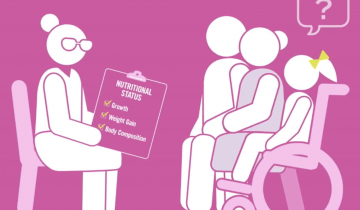
Weight, height and body composition are important indicators for development. The tools used to measure these can be different for children with cerebral palsy.
Children with cerebral palsy (CP) often grow poorly and assessment of growth in this population is further complicated by two main difficulties. Firstly, children may have joint contractures, muscular weakness, scoliosis, and/or involuntary movements that make standing or lying straight difficult, if not impossible.
When we have a physical disability, our bones can get a bit weak or osteoporotic. Something that can be improved is promoting bone health for people with cerebral palsy.
Sleep is important to all of us, but it's especially important for infants. When infants go to sleep, they start to create neural networks about what they've been learning during the day. It's estimated that as many as one in five children with disabilities have a sleep disorder, and that's higher than the rate of typically-developing children. Finding sleep interventions for these children is incredibly important so they can lay down their brain networks and continue to learn during their early childhood years.