Our son was diagnosed with complex quadriplegic cerebral palsy at six months old. At the same time, we began to notice that he was struggling with vision. With persistence we found the right diagnosis and support.
CPF Executive Director Rachel Byrne and Peter Rosenbaum, MD, developmental pediatrician and CPF Scientific Advisory Council member discuss how current thinking about Cerebral Palsy has changed over time with advances in research.
Understanding and managing healthcare and the healthcare system can be daunting for all of us. Attitudes of both providers and patients toward healthcare have experienced significant changes over the past few decades, shifting away from a focus on providers addressing problems as they arise, to more of a partnership and a shared decision-making process to maximize function, well-being, and reduce potential morbidities [1].
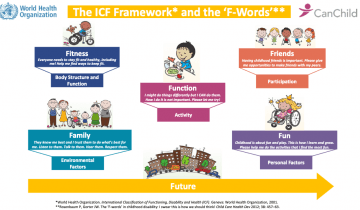
The World Health Organization has developed the ‘International Classification of Function’. This gives us a way to think about any health condition. Here we can see many ideas that we need to think about with CP. We can also see how these many ideas are connected to one another.