

Learning to see
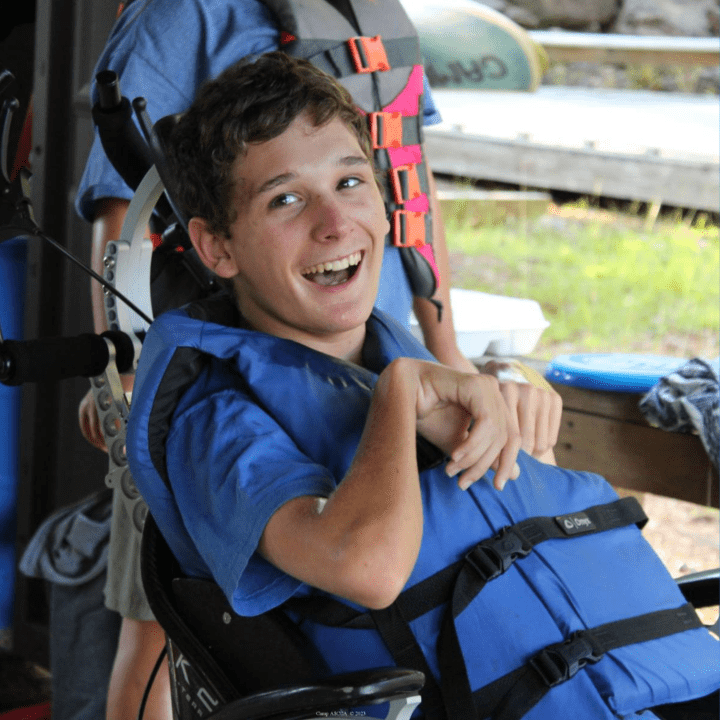
Bower was diagnosed with complex quadriplegic cerebral palsy at six months old. At the same time, we began to notice that he was struggling with vision. We persisted in finding the right diagnosis—CVI—and getting support for both conditions.
Here's what we'd like other families to know about our journey:
By nine months old, Bower wasn’t tracking toys with his eyes. You could tell he was “seeing” things but not tracking them. At the same time, he was struggling with movement. He wasn’t doing a lot of things babies his age should be doing. We’d hold a toy in front of him, and he wouldn’t reach for it. Or it would take him a little bit of time to fix his gaze on things, but he would finally see something. There was a lag.
Meanwhile, he was struggling with trunk control because he had been recently diagnosed with quadriplegic cerebral palsy, too. But, if he was just lying on his back—when he wasn’t having to fight gravity—we could see his difficulty fixing objects.
So we took him to our doctor, who said, “There’s nothing wrong with his eyes.” Because he was born prematurely and had spent time in the NICU, he’d had eye exams. He was checked for retinopathy of prematurity (when abnormal blood vessels grow in the retina) and things like that. And while the same doctor had done other eye exams on him, we were told that there was nothing wrong with his eyes. But we said: “There is something wrong.”
When he was about 18 months old, we would find that he would listen to us and would know who was coming by the sound of our footsteps. Or, for example, he would hear the car outside, smile, and say, “Papa’s home!” But when his dad entered the room, it would take about 20 to 30 seconds before he would recognize him.
Persisting for a diagnosis
I self-referred to a program for people with visual impairment in Asheville, North Carolina, where we lived at the time. Through this program, a teacher for students with visual impairments (TVI) came to our house. She watched him and said, “He has cortical visual impairment.” To this day, I’m grateful that our TVI was able to observe Bower and recognize that he had CVI.
In fact, CVI and CP are common together. It makes sense: When there’s a disruption or an injury to a developing brain, it will have an impact on movement, coordination, speech, vision, hearing, and more. Just like we have early interventions designed to harness neuroplasticity in the early years of brain development for movement, the role of the TVI should be to harness that same neuroplasticity to create new pathways to help the child learn to see.
At first, I thought of CP and CVI as one big issue, that the damage suffered as a result of CP was the same damage that was what caused the CVI, with the same challenges: learning to move and learning to see. We were trying to help Bower develop new connections that didn’t exist or that were damaged as a result of brain injury, and that our job was to help him learn.
Trusting your instincts
To get Bower’s CVI diagnosis, we had to trust our gut. If you think something’s wrong, get a second opinion. Get the best help that you can. To this day, years later, I say: ‘I am always going to find the very best for my son and find the person who is THE EXPERT in whatever he is facing.'
This isn’t always easy. I’m incredibly fortunate to work for the Cerebral Palsy Foundation and serve on the Community Council for the American Academy for Cerebral Palsy and Developmental Medicine. An index of doctors is at my fingertips. At the time, I looked for who was doing good research, and I reached out to those people. I recommend that families look at journal articles to see who’s doing current research. I urge parents to go beyond what they might see on Instagram, in bite-sized pieces.
Creating CVI-friendly spaces
Through the years, Bower’s CVI continues to show up when he’s in new situations and in unfamiliar environments. When he’s in loud places, or if he’s in very cluttered places, it’s much more difficult for him to see things. In a cluttered environment, where he has to listen more, he has to compensate. He’ll hold his head down, and his neck gets weak.
The flip side is this: When he was a little infant, we thought he could barely see. Now, in familiar environments, he can see quite well. We designed our home to be very CVI-friendly. It has a lot of natural light and walls with strong contrast. It’s very decluttered. Because his environment allows him to see better, it impacts everything else in his day. He holds his head up and has more neck strength.
Making CP and CVI visible
I try to educate those in Bower’s life, whether they’re therapists, aids, friends, or family about tips and tricks to help him see so he has successful experiences. For him, the combination of CVI and CP makes it very difficult for him to even show others or to point out what he can see, because when he makes a movement, his hand and arm will twist in ways that he doesn’t intend. It’s frustrating for him.
At the same time, for those who take the time to get to know him and watch him try, it’s obvious that he can see and discriminate between things, but it is incredibly hard for him to move and reach for them. Further, if he is nervous that there might be a sudden loud noise or a movement in his peripheral vision that may cause him to startle—which has a cascade effect of painful movements—he becomes less inclined to try to move or look. When he’s home and comfortable, in a quiet environment with nice light, no clutter, and good contrasts, he can see well and use his vision well.
A noisy, cluttered classroom is often stressful to him both visually and due to his uncontrollable movements. I try to demonstrate the difference between the environments and help educate others on how to best help him use his vision by taking these issues into consideration.
At school, make sure that everyone on your child’s team is familiar with the behaviors associated with CVI, especially the teachers’ assistants or the paraprofessionals who often don’t have the same training as therapists. Ensure that the TVI and the therapists train school staff together, so that vision and movement issues can be sorted out together; ensure they talk about how to make changes to the environment to enhance vision.
Advice and hope for other families
I’d like other families to know that, once we got a diagnosis and found the right doctor, we were told we’d constantly see improvement in Bower’s vision as he learned to use his eyes. In our particular case, it was so important to work with Bower on learning to use his eyes—really taking the time to slow down and taking those moments where he could glance at something, and then giving him time to wait, and then looking up to see it. We worked to give him time to experience that moment of vision.
Learning to use his eyes took time, it took practice, and it took consistency. Over time, it did become second nature for him. Now, I notice this most when we’re traveling. Bower loves to travel, but he clearly has a harder time seeing in new places. I have to remind myself to slow down with him. I end up taking in things a little slower, too.
Now, at 20, he’s doing great. He's enjoying the HMS School for Cerebral Palsy where he is participating in the transition program and boarding, just like any other college student would do! He likes swimming, and FaceTiming with his grandmother might be his most favorite thing in the world for him. In general, he’s a sweet, happy kid who doesn’t complain. He participates in everything that we do as a family, including our golden retriever. We travel, and we don’t exclude him from anything that we do. Making sure that he’s included is just the most important thing, both for him and also for everybody else in the community to see.
At school, make sure that everyone on your child’s team is familiar with the behaviors associated with CVI, especially the teachers’ assistants or the paraprofessionals who often don’t have the same training as therapists. Ensure that the TVI and the therapists train school staff together, so that vision and movement issues can be sorted out together; ensure they talk about how to make changes to the environment to enhance vision.